LiberoVino utilizes Commerce7's club system to create what its own club tiers. In C7 these tiers are hidden from your website and admin so that they can only be recommended via the LV app. LV also provides the ability to assign C7 promos and loyalty to your tiers. However, there are no packages or shipping schedules like your traditional clubs. LV simply uses tiers to provide benefits to its members to use when they purchase.
Other than no packages or shipping, there three very important features regarding LV club tiers:
- Qualification
- Upgradability
- Duration
These are unique concepts automatically managed by LV, but are important to planning your tier system. Unlike traditional clubs, customers are not forced to buy on a schedule. Rather, they are incentivized to purchase within their tiers duration to maintain or upgrade their benefits. If their duration expires, so do their benefits. In addition, members do choose their clubs, they qualify for them based on their initial purchase or annualized lifetime value (ALTV). Let's review how these concepts work.
Every club tier requires an ALTV. Think about this in terms of what the minimum annual expenditure is for your traditional club members. LV then determines an initial purchase by dividing by 12:
The initial purchase calculation is really just a recommendation. You can override it per tier in settings, and you can mark a tier as "upgrade only" so it is not offered at first signup—only via upgrade. Tier qualification is still your determination for each new member. However, upgrading tiers based on ALTV is automated by LV. So, let's look at that.
Upgradability is a LV recommended option to add incentive to member purchases. The option and order of upgradable tiers are determined during tier setup. Members in upgradable tiers will be notified in their monthly status how much of a spend is required to upgrade to the next tier:
Congratulations! Your recent purchase has extended your membership until 4/30/2026. However, if you spend another $450 by 2/28/2026 you automatically increase your benefits to 20% off the store and extend your membership to 6/30/2026!
Upgradability is intended to work with duration to incentivize members to purchase more than their tier minimum. Think of it as a form a gamification.
LV has no shipment commitments. Instead, we use a duration, or time limit, for each tier. Generally, the higher the ALTV, the longer the duration. Used with upgradability, duration can be used to retain club members. Once their duration expires, they can only re-sign based on their current ALTV. So, if a member upgrades tiers over time to receive maximum benefit, but then stops purchasing, they will receive an expiration warning:
Code Red! Your winery benefits are expiring in 7 days. Make a purchase soon to extend your membership until 4/30/2026. You are currently getting our maximum benefit of 20% off the store. Don't let it expire!
Durations are intended to incentivize your lower ALTV members, however your high value members will eventually not even notice them. That's because they can further extend their membership with each purchase regardless of where they are in the existing duration. In other words, if the member joins with a 3 month duration and purchases enough to extend on a regular basis, they just keep tacking months on to their existing duration up to a year. In other words, they will effectively always have another year to make their next purchase.
We understand that our radical “no commitment” concept may seem overwhelming. So, we're going to provide you with some examples based on different types of wineries. First, let's quickly review the differences between traditional and LV club tiers.
| Traditional | LiberoVino |
|---|---|
| Limited tiers | Unlimited tiers |
| Bottle based | Purchase based |
| Contains wine packages | No wine packages |
| Scheduled shipping | No scheduled shipping |
| One year commitment | No commitment |
| Member chooses club | Member qualifies for club |
| Member chooses tier | Tiers auto upgrade |
| Membership is forever until quit | Membership expires without purchase |
This is ideal for small garagista, or limited SKU wineries that want to keep things simple. These wineries are very small, hard to find and may not have tasting rooms. Customers the seek them are already prequalified to join.

| Pros | Cons |
|---|---|
| Easy to setup | Limited incentives |
| Long duration | Long potential purchase intervals. Members could disengage long before expiration. |
| Low qualification requirement | No initial purchase upsell opportunities |
| Low member maintenance | Low member interaction |
This works well for wineries with more SKUs that want to incentivize and engage more with their members. These wineries have tasting rooms, but are still relatively hard to find. Customers may stumble on them, but more likely seek them out. Note that high value members have a special non-upgradable tier.
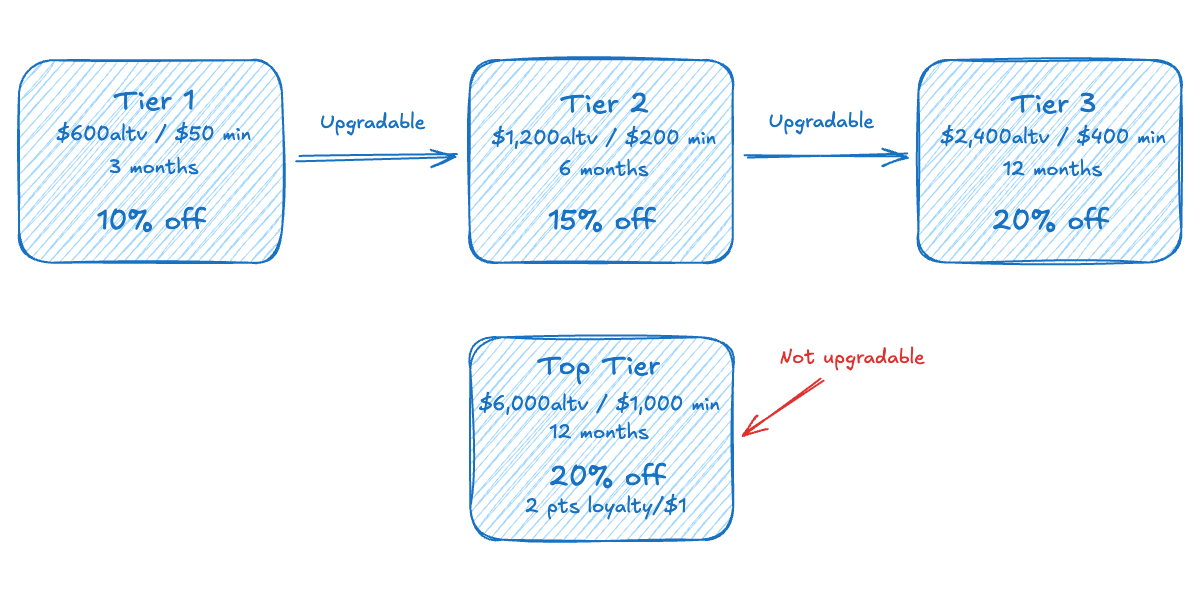
| Pros | Cons |
|---|---|
| Relatively easy setup | Requires some thought about your current customer base |
| Exclusive high value tier | No low value incentives |
| Medium engagement | Requires more communication |
This is for wineries that want to fully engage with their members at every step of their journey. This is an ideal plan for wineries with a large SKU count that includes low cost offerings as well as award winners. These wineries are well established, have well located tasting rooms and are visited by any and all that come to their region.
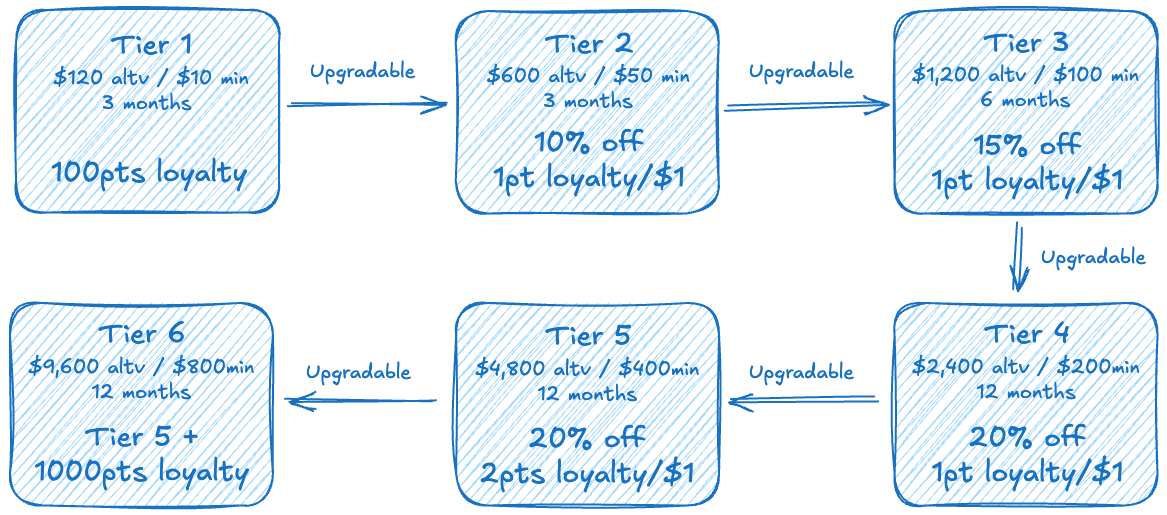
| Pros | Cons |
|---|---|
| Provides membership options for all customer types | Requires a lot of thought and analytics to setup |
| Heavy engagement opportunities, especially for clients using Mailchimp or Klaviyo | Requires well designed email templates and messaging with many iterations |
| High conversion rate = larger user base | Lower retention rates due to the ease of entry |
This is for wineries that don't offer discounts. Rather, their incentive is access to their limited wine collection. LV uses C7's built-in product/collection promo controls torestrict wines available in each tier. NOTE: A customer's first purchase can only qualify them for Tier 1.

| Pros | Cons |
|---|---|
| Easy setup | Requires changing/adding tiers with changing product availability |
| Provides members an automatic upgrade path | One size fits all unless using a parallel tier strategy |